
A Universal PCR Annealing Temperature Means Balancing Convenience with Specificity
Posted on Wednesday, February 25, 2026
By
Topic: Tips for the lab
PCR is so routine that it’s easy to forget that its success largely depends on one key parameter: the annealing temperature (Ta). If you push the annealing temperature too high, the primers won’t bind efficiently, resulting in a low yield. If the annealing temperature is too low, then mispriming, non-specific amplification, and primer dimers result.
In many singleplex assays, a practical rule of thumb is to set Ta around 3–5 °C lower than the lowest primer melting temperature (Tm). This approach works well when optimizing one target at a time, but what happens when a workflow requires amplifying many targets using a single thermocycling protocol, such as in multiplexing, high-throughput cloning, or diagnostic applications? We explore that question in this application note.
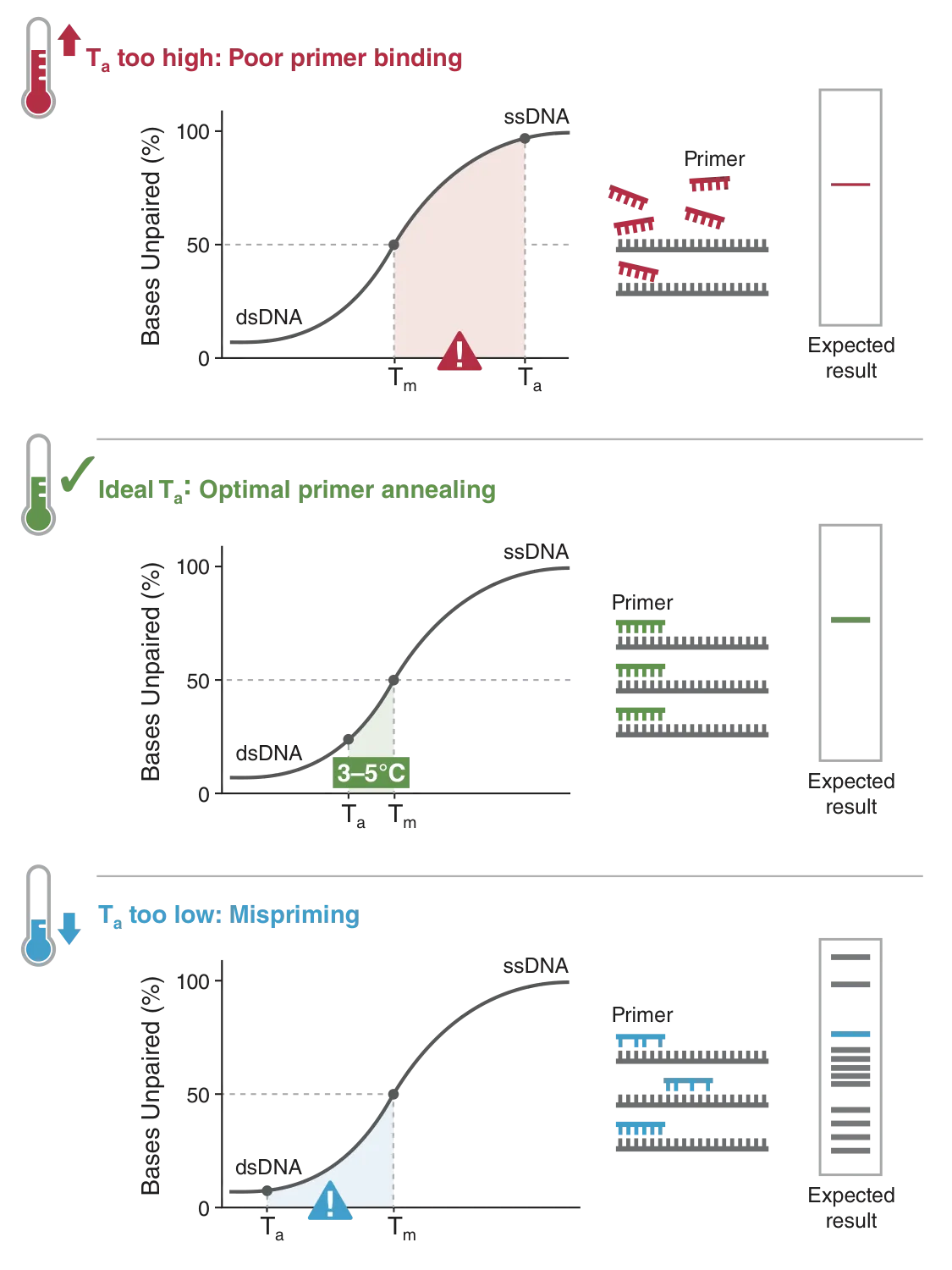
Figure 1: Typical PCR guidelines suggest setting the annealing temperature (Ta) to be 3–5 °C lower than the lowest melting temperature (Tm) primer of the assay. This ensures stable primer-template duplex (dsDNA) formation while minimizing non-specific primer binding. Using an ideal annealing temperature (Ta) ensures optimal primer binding to support amplification of the intended target. Poor primer binding occurs when the Ta is too high relative to the ideal Ta and can result in low to no product yields. Mispriming can occur if the Ta is too low relative to the ideal Ta and can result in non-specific amplification.
In these cases, the key question is not whether a single Ta can work (it often can), but how robust it is across a range of primers and targets, and what common failures occur when the Ta diverges from the optimal, calculated annealing temperature?
Because Ta is typically set using Tm, many primer sets cluster into a workable window of annealing temperatures. Widely used primer-design guidelines, such as keeping forward and reverse Tm values within ~5 °C, tend to produce primers in the high 50s to low 60s °C. This clustering increases the odds that a single Ta, if chosen carefully, will support many assays.
Some workflows benefit from a truly “universal” annealing temperature across diverse primer sets to simplify setup, reduce the need for optimization, and improve run-to-run consistency. In these cases, the choice of polymerase matters: Q5® High-Fidelity DNA Polymerases (both stand-alone enzyme and master mixes) are a strong option that perform reliably when a single annealing temperature is the goal.
For practical guidance on when and how to use a universal annealing temperature, access the full application note at the link below.
Read the Full Application NoteLearn More About Q5 High-Fidelity DNA Polymerases
Don’t miss out on our latest NEBinspired blog releases!
- Sign up to receive our e-newsletter
- Download your favorite feed reader and subscribe to our RSS feed
Be a part of NEBinspired! Submit your idea to have it featured in our blog.