8 tips to Follow When Choosing a Restriction Enzyme for In vitro mRNA Transcription for Vaccine and Therapeutics Production
Posted on Tuesday, March 17, 2026
By
Topic: What is Trending in Science
Originally published in 2021; updated in March 2026
When it comes to generating mRNA vaccines or therapeutics, you should start how you want to finish — with optimal performance. The first step of in vitro transcription (IVT) relies on choosing the best-fit restriction enzyme (RE) to linearize an IVT template, such as a plasmid, for run-off transcription. In this post, we outline practical considerations for restriction enzyme selection in IVT.
The COVID-19 pandemic necessitated the creation of vaccines at record speed, and mRNA-based vaccines have emerged as alternatives to conventional vaccine approaches. mRNA expression is transient and rapid. It is easily synthesized, standardized and scaled up — these are advantageous features because they streamline a lot of discovery and early development work. Once the viral genome is sequenced, the DNA sequence of interest (that could potentially be used as a vaccine target) can be identified within a few days. It’s been an extraordinary scientific success story that is now being applied to other types of viral infections such as rabies, influenza and RSV.
The same advantages can be applied to other therapeutic areas. In particular, bespoke personalized medicines are now possible. In early 2025, Baby KJ (Muldoon) became the first person in the world to receive a personalized CRISPR therapy, delivered using mRNA, for a life-threatening rare genetic disorder. Personalized therapies are also being applied to cancer treatment, where mRNA encodes cancer-associated antigens to prompt the immune system to target malignant cells.
The Enzymatic Path from DNA Template to Functional mRNA
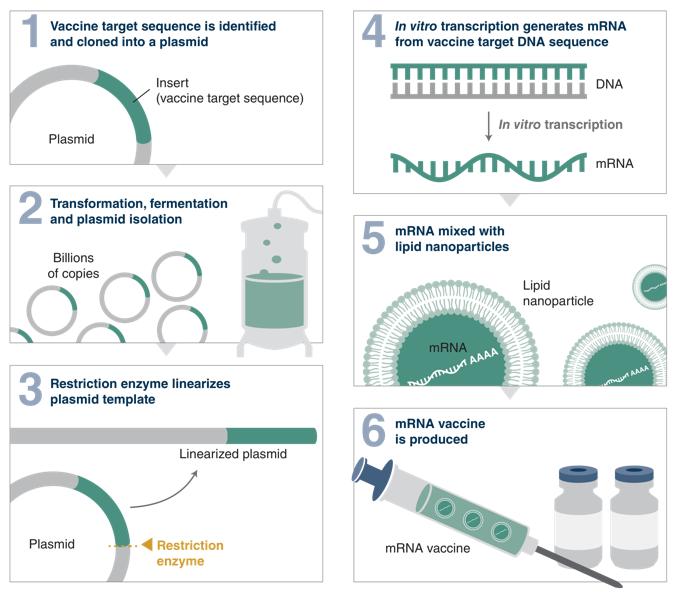
The process of making an mRNA vaccine or therapeutic using a plasmid as a template is largely enzymatic in nature: after a plasmid containing the target sequence is transformed into bacteria, fermented on a large scale and then harvested and purified, the workflow utilizes several enzymes. The plasmid is linearized with a restriction enzyme, then the DNA is used as a template for in vitro transcription to produce mRNA. In addition, mRNA requires either cotranscriptional or enzymatic capping as well as a poly(A) tail to be functional and recognized by the transcriptional machinery of the cell. The resultant mRNA will ultimately be mixed with lipid nanoparticles and injected as an LNP-packaged mRNA. And, while the in vitro mRNA synthesis process has been around for a long time and used in many biotechnology applications, synthetic mRNA was only shown to elicit an immune response in 2012 and tested as a vaccine against the Zika virus in 2017.
A simplified workflow for mRNA vaccine production utilizes several enzymes, including restriction enzymes.
One of the first critical steps in making the SARS-CoV-2 vaccine, for example, is to linearize the plasmid DNA that contains the gene encoding the viral spike protein. Restriction enzymes are used to linearize the template plasmids. Therefore, it is important to ensure restriction enzyme manufacturing and formulation are performed in an animal-free environment and adhere to the highest quality standards. NEB has been involved in the research and manufacturing of restriction enzymes for over 50 years – our expertise in this area allows us to provide helpful guidance when selecting restriction enzymes for mRNA therapeutic development:
Key Considerations for Selecting a Restriction Enzyme for mRNA manufacturing
- Animal-free manufacturing removes risks: Animal-derived materials, such as heparin, are often used in the purification of restriction enzymes. NEB offers restriction enzymes that are processed and/or formulated without animal-derived products.
- Animal-free formulation: Albumins, such as BSA, help stabilize enzymes when added to final formulations. NEB offers final formulations with recombinant Albumin (rAlbumin), ensuring no animal products are present to support FDA compliant manufacturing down the line.
- Longer RE recognition sequence for minimal plasmid processing: The longer the recognition sequence, the less likely the sequence will appear in the gene fragment, simplifying manufacturing of the plasmid template. It is therefore desirable to select restriction enzymes with longer recognition sequences. NEB offers many enzymes with 7-8 base recognition sequences.
- DNA cleavage product: Additionally, the restriction enzyme should not leave a 3´ overhang. The presence of 3´ overhangs can lead to increased production of spurious by-products, including double-stranded RNA (dsRNA) from the template during in vitro transcription (IVT).
- Stability of enzyme for optimal performance: Some enzymes are more stable than others. When selecting an enzyme, make sure you find the most stable enzyme possible (24-month expiration and -20°C storage preferred). Watch out for enzymes that have shorter shelf-life and -80°C storage recommendations (in some instances, new NEB products may state a 12-month shelf-life before 24-month real-time stability is complete).
- Incubation temperature affects individual enzymes activities: The recommended incubation temperatures for most restriction enzymes is 37°C. Be aware that some enzymes require alternate temperatures. This table lists the activity at 37°C should you require a specific enzyme for your construct.
- Detergents should comply with local regulations: Some enzymes contain small amounts of detergent, e.g., Triton-X-100, to enhance enzyme activity. It’s important to review the formulation components of your desired enzyme to ensure the levels of detergent do not conflict with local regulations, e.g., REACH in Europe.
- Type IIS Restriction Enzymes for a 'scarless' template: Type IIS restriction enzymes are the enzyme of choice for the linearization of plasmids used in vaccine development because they cut outside their recognition sequence and ensure the integrity of the poly(A) tail encoded by the manufacturer. Using a Type IIS RE, no “scar” remains on the DNA template after linearization, and no unwanted nucleotides are included at the RNA 3´ end.
- NEB offers over 30 Type IIS Restriction Enzymes, including BspQI, an isoschizomer of LguI and SapI, now available in GMP-grade*, and also BspQI-HF, which has an incubation temperature of 37°C.
- Multi-site enzymes. Some enzymes require more than one site for efficient cleavage. Often, the recommendation is to add an oligo to the reaction, which will require removal. Learn more here.
The following enzymes are popular candidates for customers considering template generation with a restriction enzyme:
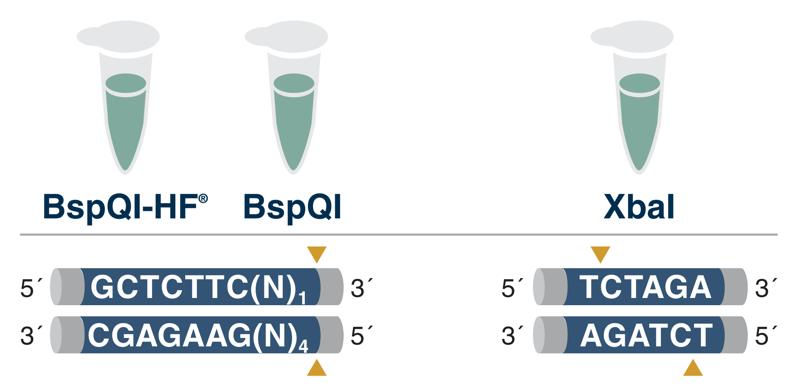

GMP-grade BspQI and XbaI formulations now available.
For more information on enzymes for your IVT process, including our GMP-grade IVT portfolio for therapeutic RNA manufacturing, please contact our Customized Solutions team. NEB has expert knowledge in finding the best restriction enzyme for your needs.
* “GMP Grade” and “GMP-grade” are branding terms NEB uses to describe products manufactured or finished at NEB’s Rowley facility. The Rowley facility was designed to manufacture products under more rigorous infrastructure and process controls to achieve more stringent product specifications and customer requirements. Products manufactured at NEB’s Rowley facility are manufactured in compliance with ISO 9001 and ISO 13485 quality management system standards. However, at this time, NEB does not manufacture or sell products known as Active Pharmaceutical Ingredients (APIs), nor does NEB manufacture its products in compliance with all of the Current Good Manufacturing Practice regulations.
Don’t miss out on our latest NEBinspired blog releases!
- Sign up to receive our e-newsletter
- Download your favorite feed reader and subscribe to our RSS feed
Be a part of NEBinspired! Submit your idea to have it featured in our blog.