Membrane Protein Expression
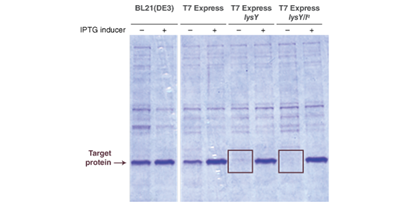
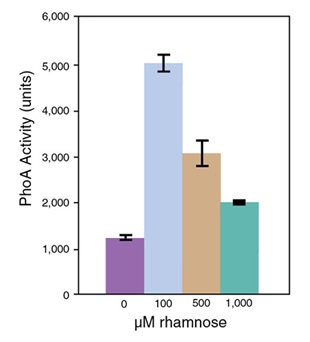
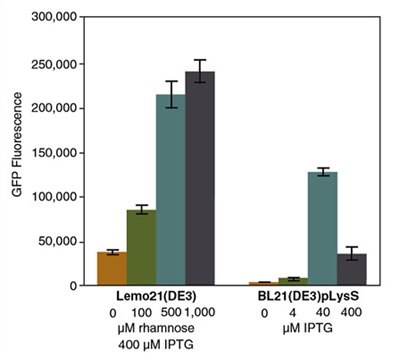
Cellular expression of recombinant membrane protein often results in protein aggregation and misfolding due to the hydrophobic nature of transmembrane segments. When using E. coli as a host, it is advantageous to express membrane proteins in moderation to avoid saturation of the membrane protein biogenesis pathway, which may lead to cell death and/or inclusion body formation. The Lemo21(DE3) protein production strain was designed for tunable T7 expression to achieve optimal assembly of transmembrane proteins or the optimal folding of soluble proteins. In standard T7 expression strains (e.g. BL21(DE3)) transcription of a target gene from a T7 promoter may be too robust and it is not easily controlled. In contrast, Lemo21(DE3) expresses a T7 RNA polymerase inhibitor protein (LysY) so that the level of target gene transcription may be precisely regulated. Lemo21(DE3) allows researchers to sample a wide range of expression levels to find the optimal conditions for each unique target protein. In the case of membrane proteins less expression often results in more functional protein.
Choose Type:
- 5 Minute Transformation Protocol (C2528)
- 5 Minute Transformation Protocol (C3013)
- High Efficiency Transformation Protocol (C3013)
- Protocol for Expression Using T7 Express lysY/Iq (C3013)
- Transformation Protocol (C2528)
- Protein Expression Using Lemo21(DE3) (C2528)
- Western Analysis (E8023)
- Protein Expression using the K. lactis Protein Expression Kit - Identification of Multi-copy Integrants
- Protein Expression using the K. lactis Protein Expression Kit - Identification of properly integrated cells
- Protein Expression with T7 Express strains
- Labeling of Proteins in Solution (E9230)
- Preparation of Media and Solutions (E6901)
- Protein expression using the K. lactis Protein Expression Kit - Cloning a PCR fragment into pKLAC2 (E1000).
- Protein Expression using the K. lactis Protein Expression Kit - Growth of strains for detection of secreted protein
- Protein Expression using the K. lactis Protein Expression Kit - Simultaneous Expression of Multiple Proteins
- Protein Expression using the K. lactis Protein Expression Kit - Transformation of K. lactis GG799 cells
- Purification of a Fusion Protein generated by The pMAL Protein Fusion and Purification System (E8200)
- Cellular Labeling (E9120)
- Protein expression using the K. lactis Protein Expression Kit - Linearization of pKLAC2 for integrative transformation of K. lactis.
- Quick Start Guide (E8200)
- Labeling Proteins in vitro (E9120)
- Cleavage of the Fusion Protein Generated Using The pMAL Protein Fusion and Purification System (E8200)
- Cloning a PCR Fragment Into a pMAL Expression Vector (E8200)
- Cellular Labeling (E9230)
- Separating the Protein of Interest from MBP after Protease Cleavage Using The pMAL Protein Fusion and Purification System (E8200)
- Fusion Constructs (E6901)
- Simplified Expression and Purification Protocol (E6901)
- Affinity Purification and On-column Cleavage (E6901)
- Construction of the Fusion Plasmid (E6901)
- Fusion Protein Expression (E6901)
- High Efficiency Transformation Protocol (C3010)
- Use of CLIP-Cell Block with CLIP-Cell Substrates (E9230)
- Primer Design for Restriction Enzyme Cloning (E6901)
- Expression Using SHuffle (C3026)
-
Avoid Common Obstacles in Protein Expression
Read how to avoid common obstacles in protein expression that prevent interactions with cellular machinery.
- Competent Cell Brochure
- Protein Expression & Purification Brochure
- Competent Cell Product Comparison
Feature Articles
Brochures
Selection Tools
- Ke, Na; Berkmen, Mehmet; Ren, Guoping; (2017) A water-soluble DsbB variant that catalyzes disulfide-bond formation in vivo Nat Chem Biol; 13, 1022-1028. PubMedID: 28628094, DOI: 10.1038/nchembio.2409
Products and content are covered by one or more patents, trademarks and/or copyrights owned or controlled by New England Biolabs, Inc (NEB). The use of trademark symbols does not necessarily indicate that the name is trademarked in the country where it is being read; it indicates where the content was originally developed. All other trademarks are the property of their respective owners. The use of this product may require the buyer to obtain additional third-party intellectual property rights for certain applications. For more information, please email busdev@neb.com.
This product is intended for research purposes only. This product is not intended to be used for therapeutic or diagnostic purposes in humans or animals.