Helicase-dependent Amplification
Helicase-dependent amplification (HDA) employs the double-stranded DNA unwinding activity of a helicase to separate strands, enabling primer annealing and extension by a strand-displacing DNA polymerase. This method was originally developed at NEB and is now used in a number of FDA-approved diagnostic assays. Like PCR, this system requires only two primers and produces short, discrete DNA products.
| Reaction Temperature | Amplicon Size | Detection Method(s) |
|---|---|---|
| 65°C | <150 nt | Lateral flow |
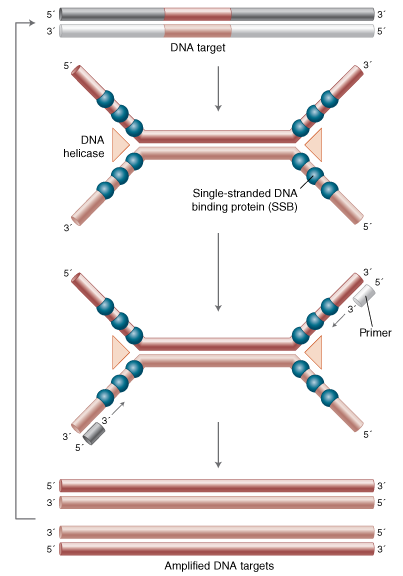
HDA utilizes a helicase to separate DNA in the presence of single-stranded binding proteins, enabling primer annealing and extension by a strand-displacing DNA polymerase.
Choose Type:
- One-Step tHDA (thermostable HDA)
- One-Step RT-HDA (Reverse Transcription tHDA)
- One-Step qHDA (Real-time quantitative tHDA)
- One-Step qRT-HDA (Real-time quantitative RT-HDA)
- Two-Step tHDA (thermostable HDA)
- Two-Step RT-HDA (Reverse Transcription tHDA)
- Two-Step qHDA (Real-time quantitative tHDA)
- Two-Step qRT-HDA (Real-time quantitative RT-HDA)
- Protocol for unwinding double stranded DNA with Tte UvrD Helicase (#M1202)
- Isothermal Amplification Brochure
Brochures
Products and content are covered by one or more patents, trademarks and/or copyrights owned or controlled by New England Biolabs, Inc (NEB). The use of trademark symbols does not necessarily indicate that the name is trademarked in the country where it is being read; it indicates where the content was originally developed. All other trademarks are the property of their respective owners. The use of this product may require the buyer to obtain additional third-party intellectual property rights for certain applications. For more information, please email busdev@neb.com.
This product is intended for research purposes only. This product is not intended to be used for therapeutic or diagnostic purposes in humans or animals.